
Prop 30: Staking Rewards Optimization Proposal: 3.5% Security Inflation with PSE-Driven Yield Support and Foundation Delegation Program
## Staking Rewards Optimization Proposal: 3.5% Security Inflation with PSE-Driven Yield Support and Foundation Delegation Program
1. Background and Objective
Under Proposal 29, the TX community approved the Coreum and Sologenic merge into TX and the Proof of Support Emissions PSE framework as the deterministic, long term supply expansion mechanism of the network. PSE emissions are distributed over 7 years and are designed to incentivize staking participation, network security, and ecosystem development.
Important Note: This proposal does not modify the PSE structure.
This proposal would reduce Staking Module Inflation to a level calculated to result in approximately 3.5% annual inflation of the circulating supply and formally implement a Foundation Delegation Program utilizing previously approved PSE allocations.
While the staking module inflation rate and corresponding block reward APR are reduced, token holders continue to receive PSE distributions over the 7-year schedule. PSE rewards are additive to block rewards, ensuring that total rewards remain competitive despite the reduction in base security inflation.
At the validator level, Foundation-backed delegation increases the total bonded stake across the network. Although the staking module inflation rate per token is reduced, validators benefit from a larger volume of delegated tokens. The higher bonded stake, combined with continued PSE-driven staking growth, supports reward continuity and is expected to maintain or increase commission income through greater stake weight and commission revenue.
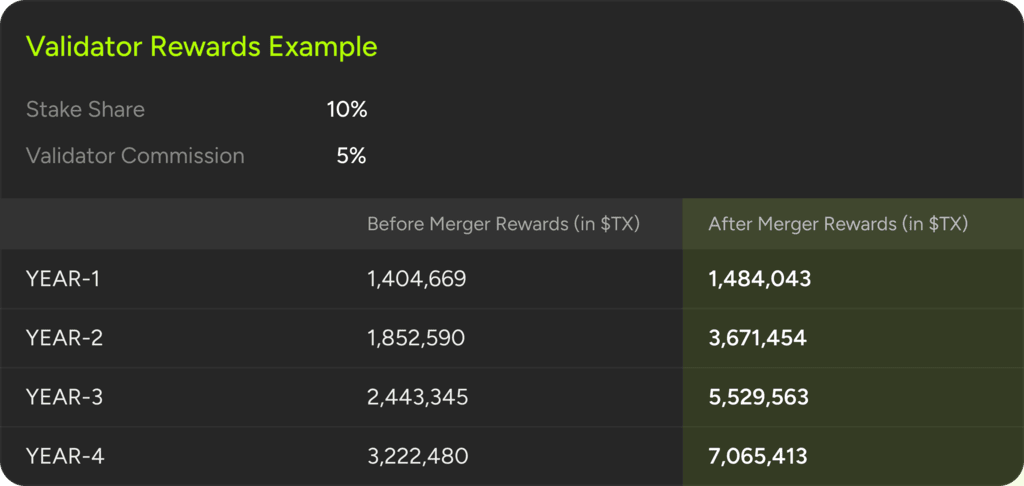
The objective is to clearly separate non-deterministic staking module inflation from structured ecosystem emissions,
improve long-term supply efficiency, and strengthen validator economics and network security through higher staking participation. A lower base inflation rate also strengthens TX's institutional positioning by demonstrating disciplined monetary policy and a transparent long-term emission structure.
The combination of lower staking module inflation, continued PSE distribution to stakers, and expanded delegated stake strengthens validator sustainability, increases bonded stake, and directly enhances overall network security.
2. Staking Module Inflation Adjustment
This proposal reduces Staking Module chain inflation to 3.5% per year for circulating supply. The staking module parameters will be configured to target approximately 3.5% annual inflation of circulating supply, subject to staking participation dynamics.
At current delegation levels, this corresponds to approximately 5.3% annual staking APR derive When combined with ongoing PSE distributions, effective staking rewards remain structurally attractive for active participants.
No changes are made to:
- PSE emission schedule approved under Proposal 29
- 7-year PSE distribution timeline
- Governance mechanics
- Validator commission structure
The 3.5% Staking Module inflation will function strictly as the network security budget.
3. Supply Modeling Impact
Under the updated configuration, projected total token supply after 7 years is approximately 110 billion TX.
Under the previously-modeled higher inflation scenario, projected total supply after 7 years was approximately 173 billion TX.
This reduces projected supply expansion by approximately 63 billion TX over the 7-year horizon, materially improving long-term
supply efficiency and monetary discipline.
The adjustment reduces passive supply growth while preserving the deterministic PSE expansion approved in Proposal 29.
4. Validator Economics and Security Impact
Under the updated structure, total validator delegations consist of:
- Original delegations made by TX holders (TX tokens derived from COREUM and SOLO)
- Community PSE distributed to TX holders
- Foundation Delegation Program
Although Staking Module Inflation is reduced, validator token flow remains supported through sustained staking participation
driven by community PSE and Foundation Delegation Program.
Since PSE emissions are automatically credited to staker delegations, they promote higher staking ratios. Increased staking
participation strengthens network security by increasing bonded stake and raising the cost of network compromise.
The structure is proposed to support a higher long-term bonded ratio, reinforcing validator stability and chain security.
Important: To be eligible for PSE distributions, a staker must maintain at least one active delegation at the time of distribution. If no active delegation exists at the distribution process, no PSE will be distributed, even if the staker had staked TX tokens during the month.
The updated structure therefore:
- Maintains validator sustainability
- Encourages higher staking participation
- Improves security through increased bonded stake
- Reduces long-term uncontrolled staking module inflation
Protocol staking rewards (3.5% inflation of circulating supply) and proof of support emissions (PSE) are now clearly separated in function. Following completion of the 7-year PSE schedule, the 3.5% staking rewards remain as the sustainable long-term validator security budget.
5. Foundation Delegation Program
This proposal formally implements a delegation mechanism using the Foundation\u2019s PSE allocation approved under Proposal 29.
A portion of Foundation-controlled PSE will be staked proportionally across validators based on voting power. This supports validator yield continuity and reinforces network security during the reduced staking module inflation regime.
In addition, a defined allocation will support validators with less than 2% voting power, subject to operational performance requirements including:
- Mainnet uptime above 98%
- Testnet uptime above 95%
- Participation in the last five governance proposals.
This mechanism reduces validator concentration risk and strengthens network resilience. Delegation allocations will be periodically reviewed to ensure decentralization targets are maintained and excessive validator concentration is avoided.
6. Structural Outcome
If approved, this proposal results in:
- Staking reward inflation calibrated to approximately 3.5% of circulating supply
- Approximately 110b TX projected supply after 7 years
- Continued execution of the PSE framework approved in Proposal 29
- Clear separation between security emissions and strategic emissions
- Formal deployment of Foundation-backed delegation
7. Governance Request
This proposal requests approval to set Staking Module Inflation parameters, calculated to result in an annual inflation rate of approximately 3.5% of the circulating supply.
This adjustment refines the emission framework while preserving transparency, determinism, validator sustainability, and long-term network security.
Community approval is requested.